> For the complete documentation index, see [llms.txt](https://help.verkada.com/llms.txt). Markdown versions of documentation pages are available by appending `.md` to page URLs; this page is available as [Markdown](https://help.verkada.com/new-alarms/installation/calculate-how-many-batteries-are-needed-for-the-bp52.md).
# Calculate How Many Batteries are Needed for the BP52
Calculate the number of VBX batteries needed to provide the desired runtime in the event of a power outage
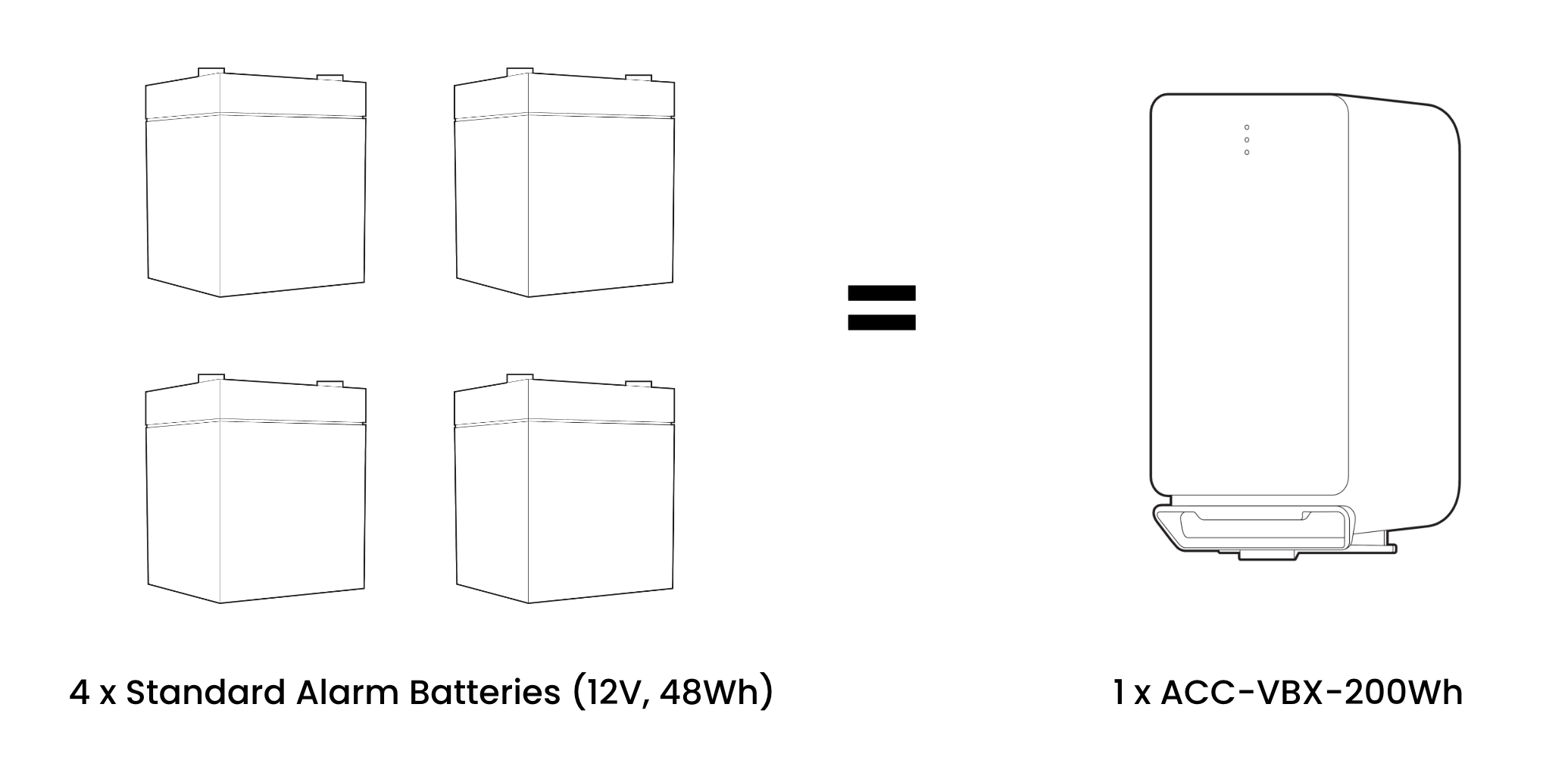
The [VBX series](https://docs.verkada.com/docs/ACC-VBX-series-datasheet.pdf) is an advanced backup battery system for the [BP52 Alarm panel](https://docs.verkada.com/docs/BP52-alarm-panel-datasheet.pdf). VBX batteries utilize lithium iron phosphate (LiFePO4) chemistry, which significantly outperforms traditional sealed lead acid (SLA) batteries in terms of lifespan and energy capacity.
***
### How many batteries do I need?
The BP52 has two integrated battery slots and supports up to two external dual battery enclosures, allowing for a total of six 200Wh batteries. To calculate the backup capacity needed for your system, add the power of all high-load devices connected to your system and multiply this number by the number of hours of backup time required.
Divide the battery capacity needed by the capacity of the ACC-VBX-200WH battery to determine the number of batteries needed:
**# of Batteries Needed** = K / 200Wh
Examples of connected devices and their power consumption are provided below:
A = 8.5W (panel idle mode)
B = 0.5W (cellular backup average power consumption)
C = 3W (expander average power consumption)
D = 4W (keypad average power consumption)
E = 6W (Security Camera - day mode average power consumption)
F = 10W (Security Camera - night mode average power consumption)
G = 8W (Intercom average power consumption)
H (Total power) = A + B+ C\*(# expanders) + D\*(# keypads) + E\*(# Cameras) + F\*(# Cameras) + G\*(# intercoms)
J = hours of backup you need
K (battery capacity needed)= H\*J
{% hint style="info" %}
**Example:** A site with a panel, cellular backup, two keypads, an expander, and two cameras can typically run for 12 hours with two VBX batteries.
{% endhint %}
***
### **Battery capacity vs temperature**
A battery’s capacity is not impacted by higher operating temperatures, but batteries operating at lower ambient temperatures have reduced capacity.
Subtract 1% capacity for every degree operating ambient temperature below 20°C.
{% hint style="info" %}
**Example:** Operating temperature is 10°C
Battery capacity is \[100% - (20-10)%] \* 200Wh
\= 90% \* 200Wh
\= 180Wh
{% endhint %}
***
### **Recharge Time**
A minimum system power of 20W is allocated to battery charging, though more power is made available to charge batteries if system loading allows.
Assuming a minimum charge power of 20W, a fully depleted battery will recharge in approximately 10 hours. Multiply 10 hours by the number of installed batteries for the time to completely recharge all batteries.
{% hint style="info" %}
**Example:** The panel operates at maximum load, and only 20W is available for charging. AC power is restored just before the four connected batteries are completely depleted.
Recharge time = 10h \*4 batteries = 40h
{% endhint %}
A maximum system power of 90W is allocated to battery charging, which may be divided between all connected batteries up to a maximum of 40W per connected pack
At maximum charge power, a fully depleted battery will recharge in approximately five hours.
---
# Agent Instructions
This documentation is published with GitBook. GitBook is the documentation platform designed so that both humans and AI agents can read, navigate, and reason over technical content effectively. Learn more at gitbook.com.
## Querying This Documentation
If you need additional information that is not directly available in this page, you can query the documentation by asking a question.
Perform an HTTP GET request on the following URL with the `ask` and `goal` query parameters:
```
GET https://help.verkada.com/new-alarms/installation/calculate-how-many-batteries-are-needed-for-the-bp52.md?ask=&goal=
```
`ask` is the immediate question: it should be specific, self-contained, and written in natural language.
`goal` is what the user is ultimately trying to achieve, the reason they need the answer. Sharing it helps GitBook give you a better, more relevant answer. A goal is most helpful when it describes the outcome the user wants rather than restating the question. For example, with `ask=how do I create an API token`, a goal like `automate deployments from our CI pipeline` lets GitBook tailor the answer to that use case.
The response will contain a direct answer to the question and relevant excerpts and sources from the documentation.
Use this mechanism when the answer is not explicitly present in the current page, you need clarification or additional context, or you want to retrieve related documentation sections.