> For the complete documentation index, see [llms.txt](https://help.verkada.com/llms.txt). Markdown versions of documentation pages are available by appending `.md` to page URLs; this page is available as [Markdown](https://help.verkada.com/air-quality/ja/ibento-arto/configure-air-quality-event-alerts.md).
# 空気質イベントアラートを設定
空気質センサーのアラートを設定して有効にする方法を学ぶ
設定ニーズに応じて、さまざまな空気質イベントのアラートを有効にできます。空気質イベントの種類について詳しくは、 [以下を参照してください](#h_71912ba2a2).
{% hint style="danger" %}
を使用するには、サイト管理者(選択したすべてのデバイス対象)である必要があります **測定値としきい値** 機能です。詳しくは、 [空気質センサーの役割と権限](/air-quality/ja/meru/roles-and-permissions-for-air-quality-sensors.md).
{% endhint %}
***
## 空気質イベントのアラートを設定する
### アラートを作成 > イベント
{% stepper %}
{% step %}
**Verkada Commandにログインします。**
{% endstep %}
{% step %}
**Commandのホームページの左側ナビゲーションで、[アラート]をクリックします。**
{% endstep %}
{% step %}
**[アラート]ページで、[マイアラート]の横にある項目をクリックします。**
{% endstep %}
{% step %}
**[イベントを選択]で、[空気質]製品タイプを選択します。**
{% endstep %}
{% step %}
**設定するイベントを検索または選択します。**
{% endstep %}
{% step %}
**(任意)一部のイベントタイプは一般的なものであり、選択するとより具体的なオプションが表示されます。指示された場合は、追加の設定手順を完了してから[次へ]をクリックします。**
{% endstep %}
{% step %}
**デバイスまたはサイトを選択します。アラートタイプに応じて、デバイス固有、サイト固有、またはすべてのデバイスを対象にイベントを設定できます。**
* 以下を選択すると **サイト** または **すべてのデバイス**を選択すると、アラートの作成後に追加された新しいデバイスでも自動的にアラートが生成されます。
クリック **完了** して続行します。
{% endstep %}
{% step %}
**(任意)一部のイベントタイプには追加の設定手順があります。その場合は、追加の手順をクリックし、設定ウィンドウの指示に従います。**
{% endstep %}
{% step %}
**[完了]をクリックし、アラートの** [**通知スケジュール**](#h_0580f3aa78)**.**
{% endstep %}
{% endstepper %}
### アラートを作成 > 通知スケジュール
{% stepper %}
{% step %}
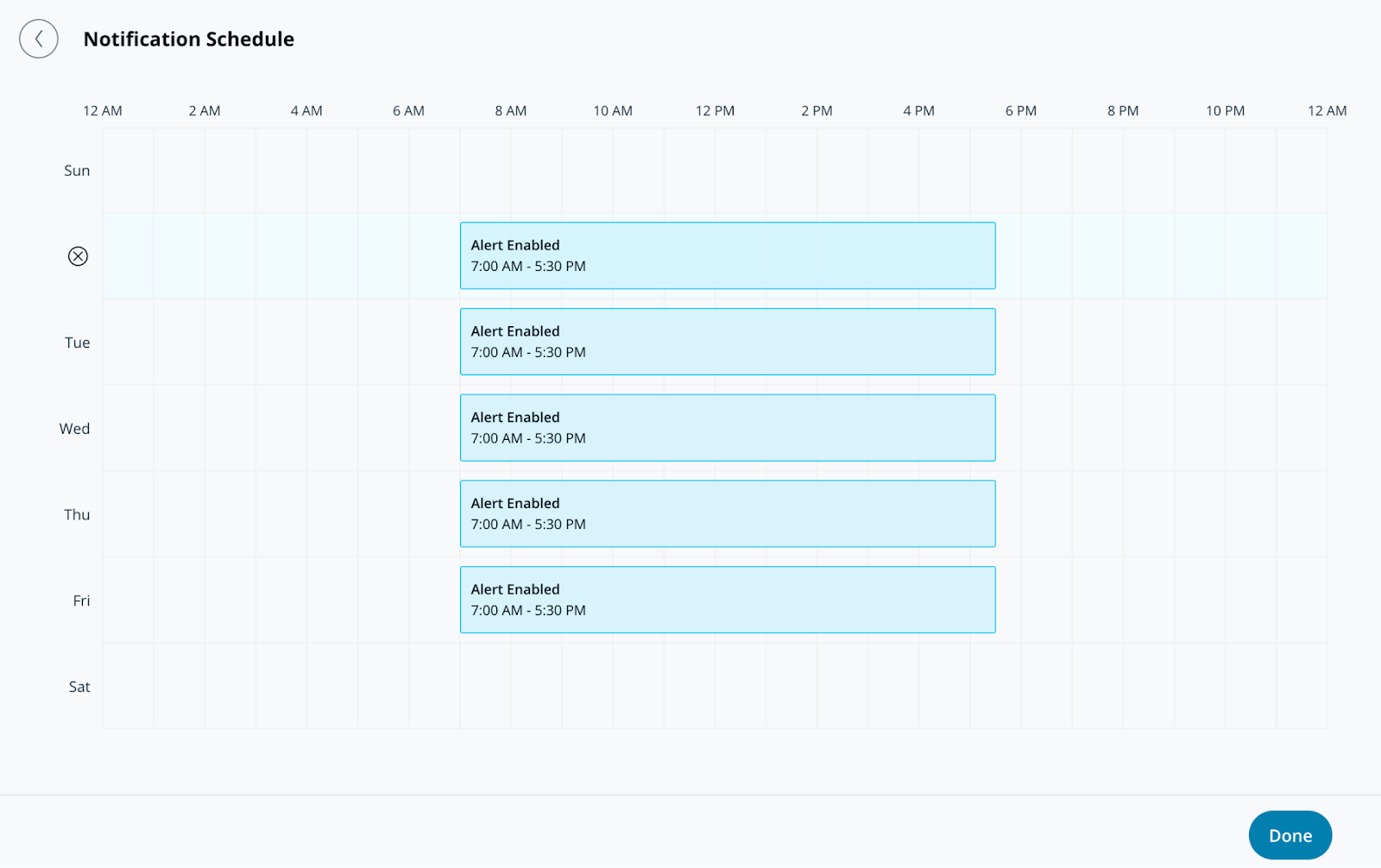
**通知スケジュールでは、アラートが通知を送信する曜日と時間を指定します。アラートは既定で24時間365日通知を送信します。**
{% endstep %}
{% step %}
**[完了]をクリックし、アラートの** [**通知**](#create-alert-greater-than-notification)**.**
{% endstep %}
{% endstepper %}
### アラートを作成 > 通知
{% stepper %}
{% step %}
**通知では、ユーザーを個別に追加するか、アラートをグループに割り当てます。**
{% endstep %}
{% step %}
**ユーザーまたはグループの横にあるドロップダウンメニューを選択して、通知方法を選びます。受信者には、プッシュ通知、SMS、メッセージングプラットフォームのアラート、またはメール通知で通知できます。**
{% hint style="info" %}
このアラートに追加された受信者は、 **共有アラート** のセクションにある **アラート** ページ。
{% endhint %}
{% endstep %}
{% step %}
**(オプション) 既定では、あなたはアラートの受信者になります。ドロップダウンメニューを選択し、\[削除] をクリックして自分を削除します。**
{% endstep %}
{% step %}
**\[完了] をクリックし、アラートの** [**オプション設定**](#optional-settings)**、または** [**アラートを完了します**](#finish-the-alert)**.**
{% endstep %}
{% endstepper %}
### オプション設定
#### アラートを作成 > オペレーション
{% stepper %}
{% step %}
**アラートからチケットを作成するには、Route to Operations をオンにします。**
{% endstep %}
{% step %}
**(オプション) \[チケットの指示] を選択してチケットに情報を追加し、\[完了] をクリックします。**
{% endstep %}
{% step %}
**\[完了] をクリックして次へ進み、** [**アラートを完了します**](#finish-the-alert)**.**
{% endstep %}
{% endstepper %}
#### アラートを作成 > デバイスアクション
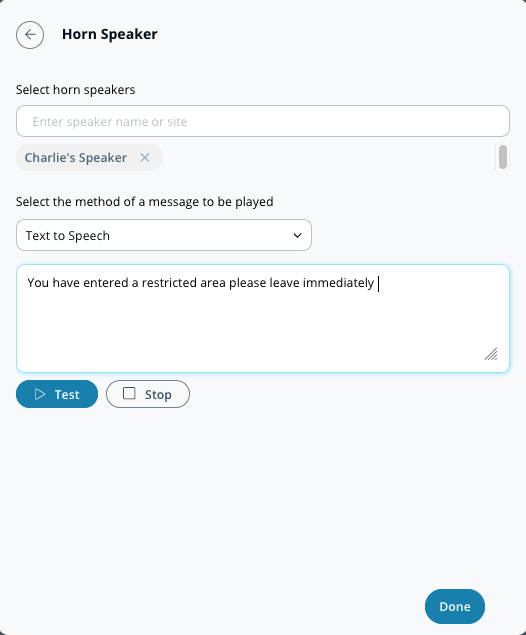
個人への通知に加えて、アラートがトリガーされたときにホーンスピーカーが再生するように設定できます。これらのアラートは、テキスト読み上げまたはアップロードしたMP3ファイルにできます。
{% stepper %}
{% step %}
**デバイスアクションでは、メッセージを再生するホーンスピーカーを選択します。**
{% endstep %}
{% step %}
**通知方法の設定を選択します(テキスト読み上げまたは音声ファイル)。**
a. の場合、 **テキスト読み上げ、** 200文字までのメッセージを入力します。\
b. の場合、 **音声ファイル、** ファイルをドラッグ&ドロップするか、 **ファイルを選択** して音声クリップをアップロードします。
{% endstep %}
{% step %}
**\[完了] をクリックして次へ進み、** [**アラートを完了します**](#finish-the-alert)**.**
{% endstep %}
{% endstepper %}
### アラートを完了する
{% stepper %}
{% step %}
**設定ウィンドウの右下で、\[次へ] をクリックします。**
{% endstep %}
{% step %}
**アラートの説明的な名前を入力します。**
{% endstep %}
{% step %}
**\[完了] をクリックしてセットアップを完了します。**
{% endstep %}
{% endstepper %}
### さまざまな空気質イベントタイプを理解する
| アラートタイプ | 説明 |
| --------------------------- | ---------------------------------------------------------------------------- |
| **学校** | 学校向けのベイプアラートを受信します。 |
| **学校およびホスピタリティ施設** | ベイプ、騒音、およびタンパーのアラートを受信します。 |
| **サーバールーム、データセンター、または冷蔵設備** | 温度および湿度のアラートを受信します。 |
| **従業員の健康と安全** | 騒音、CO2、一酸化炭素、TVOC、ホルムアルデヒド、およびPM 2.5のアラートを受信します。 |
| **オンライン/オフライン** | 空気質デバイスの状態がオンラインまたはオフラインに変わりました。 |
| **カスタム空気質測定値** | さまざまな [空気質センサーの測定値](/air-quality/ja/sensdta/air-quality-sensor-readings.md). |
---
# Agent Instructions
This documentation is published with GitBook. GitBook is the documentation platform designed so that both humans and AI agents can read, navigate, and reason over technical content effectively. Learn more at gitbook.com.
## Querying This Documentation
If you need additional information that is not directly available in this page, you can query the documentation by asking a question.
Perform an HTTP GET request on the following URL with the `ask` and `goal` query parameters:
```
GET https://help.verkada.com/air-quality/ja/ibento-arto/configure-air-quality-event-alerts.md?ask=&goal=
```
`ask` is the immediate question: it should be specific, self-contained, and written in natural language.
`goal` is what the user is ultimately trying to achieve, the reason they need the answer. Sharing it helps GitBook give you a better, more relevant answer. A goal is most helpful when it describes the outcome the user wants rather than restating the question. For example, with `ask=how do I create an API token`, a goal like `automate deployments from our CI pipeline` lets GitBook tailor the answer to that use case.
The response will contain a direct answer to the question and relevant excerpts and sources from the documentation.
Use this mechanism when the answer is not explicitly present in the current page, you need clarification or additional context, or you want to retrieve related documentation sections.