> For the complete documentation index, see [llms.txt](https://help.verkada.com/llms.txt). Markdown versions of documentation pages are available by appending `.md` to page URLs; this page is available as [Markdown](https://help.verkada.com/air-quality/configuration/third-party-vms-integrations-for-air-quality-sensor-events.md).
# Third-Party VMS Integrations for Air Quality Sensor Events
Receive and view sensor event alerts from an on-premise video management system
Air Quality sensors offer your organization a way to monitor essential indoor air quality factors, such as [vape index](/air-quality/sensor-data/air-quality-sensor-readings.md), [temperature](/air-quality/sensor-data/air-quality-sensor-readings.md), [humidity](/air-quality/sensor-data/air-quality-sensor-readings.md), and more.
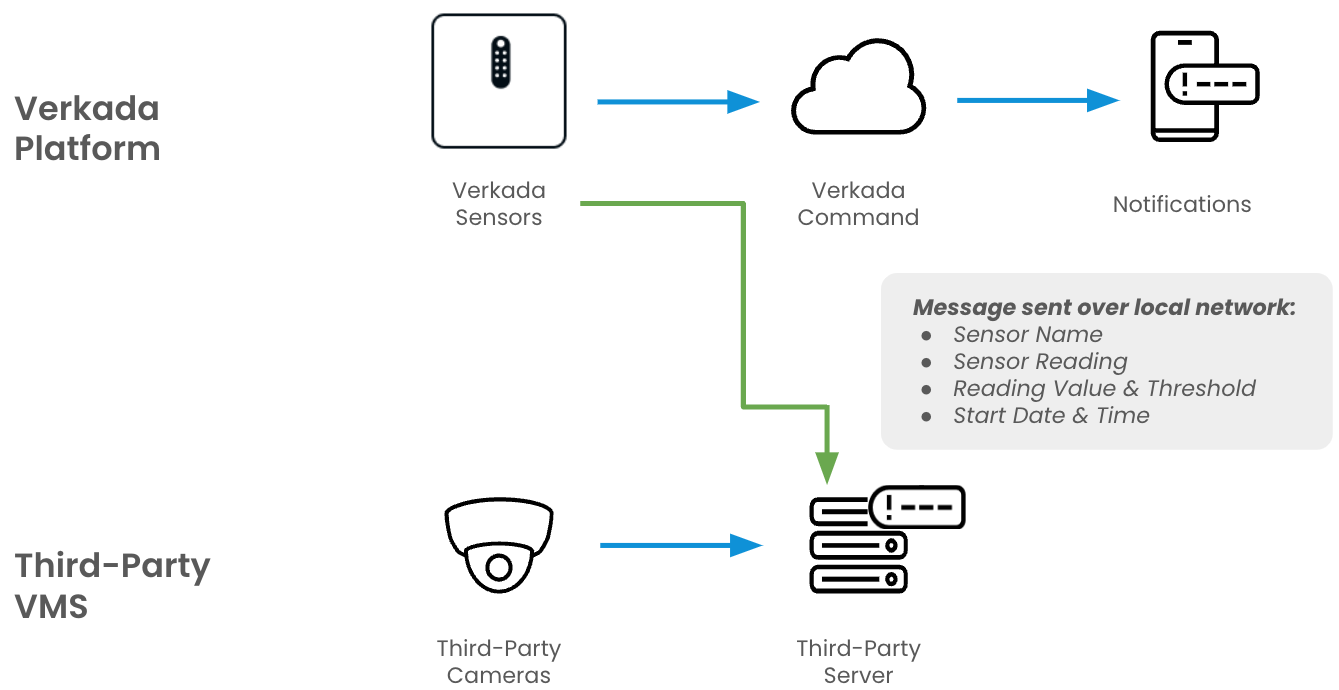
Third-party video management system (VMS) integrations allow Verkada sensors to send alert events to on-premise VMS, such as Milestone X-Protect, Wisenet WAVE, or exacqVision. These integrations allow you to receive and view sensor event data within your VMS system, eliminating the need to build custom APIs or manually match sensor events to camera footage.
Each VMS integration varies based on the manufacturer's integration prerequisites. You will receive an alert that can be easily linked to a camera and includes the sensor name, sensor reading, reading value, whether the threshold was surpassed, and a timestamp.
{% hint style="warning" %}
The video integration feature only sends alert event data. It does not send time-series data or graph data.
{% endhint %}
#### Supported third-party VMS providers
* Milestone X-Protect
* Wisenet WAVE
* exacqVision
* Video Insight
***
## Enable third-party VMS integrations
{% hint style="danger" %}
You need [Org Admin and Site Admin permissions](/command/users-and-permissions/roles-and-permissions-for-command.md) for each site where the sensors are located to enable this feature.
{% endhint %}
To activate the Third-Party VMS Integration functionality on your sensors, you first need to enable the feature for your organization.
{% stepper %}
{% step %}
**In Verkada Command, go to All Products > Admin.**
{% endstep %}
{% step %}
**Select Privacy & Security> Feature Manager.**
{% endstep %}
{% step %}
**Under Air Quality > Third-Party VMS Integration, select Enable from the dropdown.**
{% endstep %}
{% endstepper %}
### Set up a third-party VMS integration
{% hint style="warning" %}
A sensor may only be connected to a single VMS server. Once integrated, the device will appear as **Unavailable** if a different video integration is initiated.
{% endhint %}
{% hint style="danger" %}
The sensor must be on the same local network and VLAN as the third-party VMS server.
{% endhint %}
{% stepper %}
{% step %}
**In Command, go to All Products > Air Quality.**
{% endstep %}
{% step %}
**On the left navigation, click VMS Integration.**
{% endstep %}
{% step %}
**Select a Video Management System.**
{% endstep %}
{% step %}
**Each VMS integration will be slightly different, but you will need to enter the following:**
1. Server **IP Address**: The IP address of your VMS server.
2. Server **Port** Number: The port on your VMS server that will be able to receive events.
3. (If applicable) **Username**: A configured username that is capable of receiving alerts into the system.
4. If applicable) **Password**: Password for the configured user above.
5. Click **Next.**
{% endstep %}
{% step %}
**Select the sensors you would like to connect and click Integrate Devices.**
{% endstep %}
{% step %}
**The devices will begin to receive the configuration and attempt to establish a connection to the VMS server. This may take a few minutes to complete.**
{% endstep %}
{% endstepper %}
***
### Status indicators on Command
* Green: Successfully connected or submitted an event.
* Orange: The device may be offline or has **not yet** submitted a status to the backend.
* Red: Failed to connect or failed to submit an event to the VMS server.
{% hint style="warning" %}
The **Refresh** button checks whether any devices have submitted events or attempted connections to the server. It does not force the device to connect to the server.
{% endhint %}
***
## Manage Third-Party VMS Integration
### Edit integration
{% stepper %}
{% step %}
**In Command, go to All Products > Air Quality.**
{% endstep %}
{% step %}
**On the left navigation, click VMS Integration.**
{% endstep %}
{% step %}
**You will see a list of existing integrations.**
{% endstep %}
{% step %}
**Next to the integration you want to edit, click > Edit Integration.**
a. Modify the configuration as needed.\
b. Click **Edit Devices.**\
c. Click **Save Changes.**
{% endstep %}
{% endstepper %}
### Delete integration
{% stepper %}
{% step %}
**In Command, go to All Products > Air Quality.**
{% endstep %}
{% step %}
**On the left navigation, click VMS Integration.**
{% endstep %}
{% step %}
**Next to the integration you want to delete, click > Delete Integration.**
a. Enter the confirmation code.\
b. Click **Delete.**
{% endstep %}
{% endstepper %}
***
## What needs to be done on the VMS Server Side?
The process differs between each VMS. Refer to their documentation for precise instructions.
In general, the following steps must be completed:
* Create generic or user-defined events for each device & reading.
* Create alarms for the events.
* Create rules to set up custom actions, such as trigger camera recording or notifications.
* Create mappings between these different elements:
* Event → Alarms → Rules → 3rd Party Camera Association
You may need to repeat these steps for each device.
---
# Agent Instructions
This documentation is published with GitBook. GitBook is the documentation platform designed so that both humans and AI agents can read, navigate, and reason over technical content effectively. Learn more at gitbook.com.
## Querying This Documentation
If you need additional information that is not directly available in this page, you can query the documentation by asking a question.
Perform an HTTP GET request on the following URL with the `ask` and `goal` query parameters:
```
GET https://help.verkada.com/air-quality/configuration/third-party-vms-integrations-for-air-quality-sensor-events.md?ask=&goal=
```
`ask` is the immediate question: it should be specific, self-contained, and written in natural language.
`goal` is what the user is ultimately trying to achieve, the reason they need the answer. Sharing it helps GitBook give you a better, more relevant answer. A goal is most helpful when it describes the outcome the user wants rather than restating the question. For example, with `ask=how do I create an API token`, a goal like `automate deployments from our CI pipeline` lets GitBook tailor the answer to that use case.
The response will contain a direct answer to the question and relevant excerpts and sources from the documentation.
Use this mechanism when the answer is not explicitly present in the current page, you need clarification or additional context, or you want to retrieve related documentation sections.