> For the complete documentation index, see [llms.txt](https://help.verkada.com/llms.txt). Markdown versions of documentation pages are available by appending `.md` to page URLs; this page is available as [Markdown](https://help.verkada.com/access-control/integrations-and-alerts/manage-doors-via-api.md).
# Manage Doors via API
Manage Verkada access controlled doors with third-party platforms
Third-party platforms can programmatically control Verkada-managed doors with the **Enable Door Management via API** setting enabled using Verkada’s access control API.
### Applicable Door Management APIs
The following Access Control API categories include APIs that require all doors controlled with the API to have **Enable Door Management via API** enabled.
* [Access Door Unlock APIs](https://apidocs.verkada.com/reference/postaccessadminapiunlockviewv1)
* [Door Exception Calendar APIs](https://apidocs.verkada.com/reference/getaccessdoorexceptioncalendarsviewv1)
* [Access Level APIs](https://apidocs.verkada.com/reference/getaccesslevelview)
{% hint style="warning" %}
See [Verkada API Docs](https://apidocs.verkada.com/) for details on specific API endpoints that require this setting.
{% endhint %}
***
## Command Configuration
Before a door can be controlled via API, permissions to control the door via API need to be enabled at the following levels:
* [Organization level](/access-control/integrations-and-alerts/manage-doors-via-api.md)
* [Site level](/access-control/integrations-and-alerts/manage-doors-via-api.md)
* [Door level](/access-control/integrations-and-alerts/manage-doors-via-api.md)
### Organization level configuration
{% stepper %}
{% step %}
**In Verkada Command, go to All Products > Access.**
{% endstep %}
{% step %}
**On the left navigation, click Access Settings .**
{% endstep %}
{% step %}
**Toggle on Enable Door Management via API.**
{% endstep %}
{% endstepper %}
### Site level configuration
{% stepper %}
{% step %}
**In Verkada Command, go to All Products > Access.**
{% endstep %}
{% step %}
**From the All Sites dropdown, select a site.**
{% endstep %}
{% step %}
**At the top, click Access Settings .**
{% endstep %}
{% step %}
**Toggle on Enable Door Management via API.**
{% endstep %}
{% endstepper %}
### Door level configuration
{% stepper %}
{% step %}
**In Verkada Command, go to All Products > Access.**
{% endstep %}
{% step %}
**From the All Sites dropdown, select a site.**
{% endstep %}
{% step %}
**Select a door and click Settings .**
{% endstep %}
{% step %}
**Under Installer Settings, toggle on Enable Door Management via API.**
{% endstep %}
{% endstepper %}
***
## Reviewing API Unlock Events
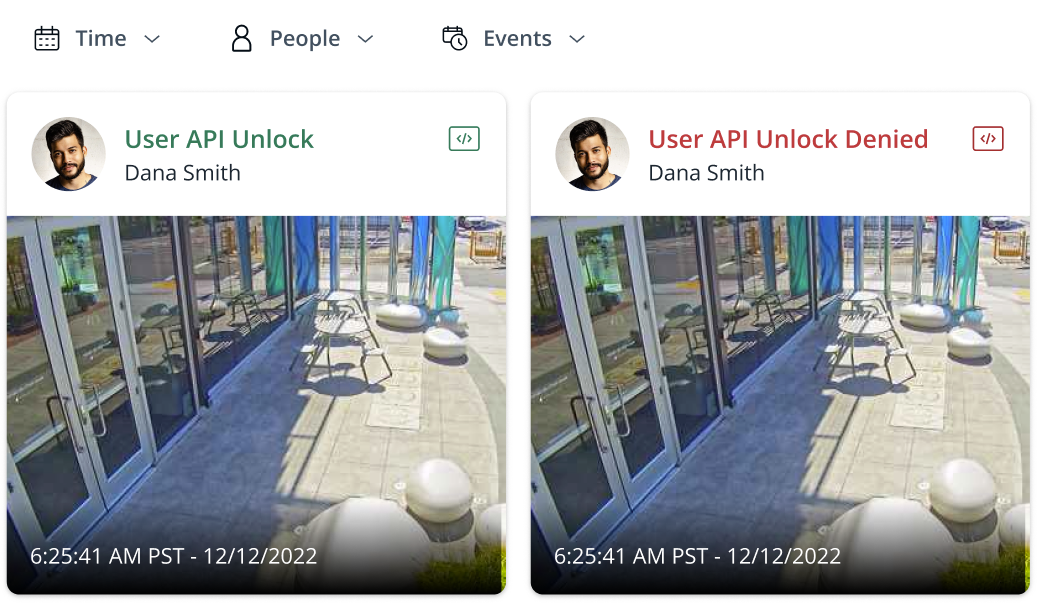
When a door unlock API call is used, an event is logged in Command indicating that a request to unlock a door via API was made. The event will indicate whether access was granted, what API was used, and (if applicable) an access user associated with the request.
Events associated with a door unlock API request can be viewed on the access control [Reports](/access-control/integrations-and-alerts/access-control-reports.md) page or on the [door page](/access-control/configuration/configure-a-door-in-command/view-access-control-doors.md) for a relevant door.
Events associated with door unlock API requests include the following information:
* **Event Name:** Access Granted or Access Denied
* **Method:** User Unlock API or Admin Unlock API
* **User** (if method is User Unlock API): Access user associated with the unlock request.
* **Credential:** Name of the [Verkada API Key](https://apidocs.verkada.com/reference/quick-start-guide) used to make the API unlock request.
***
{% hint style="info" %}
**Prefer to see it in action?** Check out the [video tutorial](https://www.youtube.com/watch?v=nvJkh2jyOjU).
{% endhint %}
---
# Agent Instructions
This documentation is published with GitBook. GitBook is the documentation platform designed so that both humans and AI agents can read, navigate, and reason over technical content effectively. Learn more at gitbook.com.
## Querying This Documentation
If you need additional information that is not directly available in this page, you can query the documentation by asking a question.
Perform an HTTP GET request on the following URL with the `ask` and `goal` query parameters:
```
GET https://help.verkada.com/access-control/integrations-and-alerts/manage-doors-via-api.md?ask=&goal=
```
`ask` is the immediate question: it should be specific, self-contained, and written in natural language.
`goal` is what the user is ultimately trying to achieve, the reason they need the answer. Sharing it helps GitBook give you a better, more relevant answer. A goal is most helpful when it describes the outcome the user wants rather than restating the question. For example, with `ask=how do I create an API token`, a goal like `automate deployments from our CI pipeline` lets GitBook tailor the answer to that use case.
The response will contain a direct answer to the question and relevant excerpts and sources from the documentation.
Use this mechanism when the answer is not explicitly present in the current page, you need clarification or additional context, or you want to retrieve related documentation sections.